
Understanding the Chihuahua Breed Standard: AKC vs. FCI
In this section, we will detail the Chihuahua breed standards as defined by two of the world’s foremost canine organizations: the American Kennel Club (AKC) and the Fédération Cynologique Internationale (FCI).
If you are a resident of the United States, the AKC standard will serve as your primary reference for understanding the Chihuahua breed.
Conversely, if you reside in one of the FCI’s 99 member countries (a complete list of which can be found at the end of this article for your convenience), the FCI standard will be your guiding reference.
We will now present the specific details of both organizations’ standards.
AKC Chihuahua Breed Standard
GENERAL APPEARANCE:
A graceful, alert, swift-moving compact little dog with saucy expression,
and with terrier-like qualities of temperament.
SIZE, PROPORTION, SUBSTANCE:
Weight – A well balanced little dog not to exceed 6 pounds.
Proportion – The body is off-square; hence, slightly longer when measured from point of shoulder to point of buttocks than height at the withers. Somewhat shorter bodies are preferred in males.
Disqualification – Any dog over 6 pounds in weight.
HEAD:
A well rounded «apple dome» skull, with or without molera.
Expression – Saucy
Eyes – Full, round, but not protruding, balanced, set well apart-luminous dark or luminous ruby. Light eyes in blond or white-colored dogs permissible. Blue eyes or a difference in the color of the iris in the two eyes, or two different colors within one iris should be considered a serious fault.
Ears – Large, erect type ears, held more upright when alert, but flaring to the sides at a 45 degree angle when in repose, giving breadth between the ears.
Stop – Well defined. When viewed in profile, it forms a near 90 degree angle where muzzle joins skull
Muzzle – Moderately short, slightly pointed. Cheeks and jaws lean.
Nose – Self-colored in blond types, or black. In moles, blues, and chocolates, they are self-colored. In blond types, pink noses permissible.
Bite – Level or scissors. Overshot or undershot, or any distortion of the bite or jaw, should be penalized as a
serious fault. A missing tooth or two is permissible.
Disqualifications – Broken down or cropped ears.
NECK, TOPLINE, BODY:
Neck – Slightly arched, gracefully sloping into lean shoulders.
Topline – Level
Body – Ribs rounded and well sprung (but not too much «barrel-shaped»).
Tail – Moderately long, carried sickle either up or out, or in a loop over the back with tip just touching
the back. (Never tucked between legs.)
Disqualifications – Docked tail, bobtail.
FOREQUARTERS:
Shoulders – Lean, sloping into a slightly broadening support above straight forelegs that set well under, giving free movement at the elbows. Shoulders should be well up, giving balance and soundness, sloping into a level back (never down or low). This gives a well developed chest and strength of forequarters.
Feet – A small, dainty foot with toes well split up but not spread, pads cushioned. (Neither the hare nor the cat foot.) Dewclaws may be removed.
Pasterns – Strong.
Hindquarters – Muscular, with hocks well apart, neither out nor in, well let down, firm and sturdy. Angulation – Should equal that of forequarters. The feet are as in front. Dewclaws may be removed.
HINDQUARTERS:
Muscular, with hocks well apart, neither out nor in, well let down, firm and
sturdy. Angulation – Should equal that of forequarters. The feet are as in front. Dewclaws may be removed.
COAT:
IN THE SMOOTH COATS – The coat should be of soft texture, close and glossy. (Heavier coats with undercoats permissible.) Coat placed well over body with ruff on neck preferred, and more scanty on head and ears. Hair on tail preferred furry.
IN LONG COATS – The coat should be of a soft texture, either flat or slightly wavy, with undercoat preferred.
Ears – Fringed.
Tail – Full and long (as a plume). Feathering on feet and legs, pants on hind legs and large ruff on the neck desired and preferred (The Chihuahua should be groomed only to create a neat appearance.)
Disqualification – In Long Coats, too thin coat that resembles bareness.
COLOR:
Any color – Solid, marked or splashed.
GAIT:
The Chihuahua should move swiftly with a firm, sturdy action, with good reach in front equal to the drive from the rear. From the rear, the hocks remain parallel to each other, and the foot fall of the rear legs follows directly behind that of the forelegs. The legs, both front and rear, will tend to converge slightly toward a central line of gravity as speed increases. The side view shows good, strong drive in the rear and plenty of reach in the front, with head carried high. The topline should remain firm and the backline level as the dog moves.
TEMPERAMENT:
Alert, projecting the ‘terrier-like’ attitudes of self importance, confidence, self-reliance.
DISQUALIFICATIONS:
Any dog over 6 pounds in weight. Broken down or cropped ears. Docked tail, bobtail. In Long Coats, too thin coat that resembles bareness.
Approved August 12, 2008
Effective October 1, 2008
To view the full details and global recognition, consult the AKC Chihuahua Breed Standard on their official website.
FCI Chihuahua Breed Standard
GENERAL APPEARANCE:
This dog has a compact body. Of great importance is the fact that his skull is apple-shaped and that he carries his moderately long tail very high, either curved or forming the shape of a semicircle with the tip pointing towards the loin region.
IMPORTANT PROPORTIONS:
Length of body slightly greater than height at withers. Desired, however, is an almost square body, especially in males. In bitches, because of the function of reproduction, a slightly longer body is permitted.
BEHAVIOUR / TEMPERAMENT:
Quick, alert, lively and very courageous.
HEAD:
CRANIAL REGION:
Skull: Well-rounded apple head (a characteristic of the breed).
Stop: Well marked, deep and broad as the forehead is rounded above
the set-on of muzzle.
FACIAL REGION:
Nose: Any colour permitted. Moderately short, pointing slightly
upwards.
Muzzle: Short, straight seen from side, broad at set-on, tapering
towards the tip.
Lips: Lean and close fitting.
Jaws/Teeth: Scissor or pincer bite. Overshot, undershot, as well as any other anomaly in position of upper or lower jaw must be strictly penalized.
Cheeks: Only slightly developed, very clean.
Eyes: Large, roundish in shape, very expressive, not protruding, perfectly dark. Light eyes permissible, but not desired.
Ears: Large, upright, widely open, broad at set-on, gradually tapering towards their slightly rounded tip. In repose inclined laterally forming an angle of 45°
Neck: Upper profile slightly arched. Medium length. Thicker in dogs than in bitches. Without dewlap. In the long-haired variety, the presence of a neck-ruff with longer hair is highly desirable.
BODY:
Compact and well built.
Topline: Level.
Withers: Only slightly marked.
Back: Short and firm.
Loin: Strongly muscled.
Croup: Broad and strong; almost flat or slightly sloping.
Chest: Ribcage broad and deep, ribs well sprung. Seen from front, roomy but not exaggerated. Seen from side, reaching to elbows. Not barrel shaped.
Underline and belly: Formed by a clearly tucked up belly. Slack belly is permitted but not desired.
TAIL:
Set on high, flat in appearance, of moderate length; broad at root, tapering gradually towards the tip. Tail carriage is an important characteristic of the breed : when the dog is moving it is carried either high in a curve or in a semicircle with tip towards the loin region, which gives balance to the body, it should never be carried between the hindlegs nor curled below the backline. The hair on the tail depends on the variety and is in harmony with the body coat. In the long-haired variety, the tailcoat forms a plume. Tail is pendant in repose and forms a slight hook.
LIMBS
FOREQUARTERS:
General appearance: Forelegs seen from the front form a straight line with the elbows. Seen from the side, they are upright.
Shoulder: Clean and moderately muscled.
Upper arm: Good angulation between shoulder-blade and upper arm.
Elbow: Firm and fitting close to body, which ensures free movement.
Forearm: Straight and of good length.
Metacarpus (Pastern): Slightly sloping, strong and flexible.
Forefeet: Very small and oval with toes well apart but not splayed (neither hare- nor cat-foot). Nails particularly well arched and moderately long. Pads well developed and very elastic. Dewclaws are not desirable.
HINDQUARTERS:
General appearance: Hindlegs well muscled with long bones, vertical and parallel to each other with good angulation at hip, knee and hock joints, in harmony with angulation of forequarters.
Metatarsus (Rear pastern): Short hocks with well-developed Achilles’ tendons; seen from rear, they are well apart straight and vertical.
Hind feet: Very small and oval with toes well apart but not splayed (neither hare- nor cat-foot). Nails particularly well arched and moderately long. Pads well developed and very elastic. Dewclaws are not desirable.
GAIT / MOVEMENT:
Steps are long, springy, energetic and active with good reach and drive. Seen from rear, hind legs should move almost parallel to each other, so that the footprints of the hind feet fit directly into those of the front feet. With increasing speed, the limbs
show a tendency to converge towards the median plane (single track). Movement remains free and springy without visible effort, head raised and back firm.
SKIN:
Smooth and elastic all over body
COAT:
Hair: In this breed there are two varieties of coat
Smooth-haired: Coat is short, lying close all over body. If there is an undercoat, the hair is somewhat longer; sparse coat on throat and belly permissible; slightly longer on neck and tail, short on face and ears. Coat is glossy and its texture is soft. Hairless dogs are not tolerated.
Longed-haired: Coat should be fine and silky, smooth or slightly wavy. Not too thick undercoat desired. Coat is longer, forming feathering on ears, neck, rear of front and hind legs, on feet and on tail. Dogs with long billowing coat will not be accepted.
COLOUR:
All colours in all possible shades and combinations are admitted, except merle colour.
SIZE AND WEIGHT:
In this breed, only the weight is taken into consideration, not the height.
Weight: 1 to 3 kg. Ideal weight: between 1,5 and 2,5 kg.
Subjects weighing less than 1 kg and more than 3 kg shall be disqualified.
FAULTS:
Any departure from the foregoing points should be considered a fault and the seriousness with which the fault should be
regarded should be in exact proportion to its degree and its effect upon the health and welfare of the dog.
- Missing teeth.
- “Double teeth” (persistence of temporary teeth).
- Pointed ears.
- Short neck.
- Long body.
- Roach or hollow back (Lordosis or Kyphosis).
- Steep croup.
- Narrow chest, flat ribcage.
- Tail: incorrect set-on, short or twisted.
- Short limbs.
- Out at elbow.
- Too close behind.
SEVERE FAULTS:
- Narrow skull.
- Eyes small, deep set or protruding.
- Long muzzle.
- Under or overshot mouth.
- Unstable stifle.
DISQUALIFYING FAULTS:
- Aggressive or overly shy.
- Any dog clearly showing physical or behavioural abnormalities.
- Deer type dogs (dogs with an atypical or extremely stylized
structure: refined head, long neck, slender body, long limbs). - Dogs with an open fontanel.
- Drop ear or short ear.
- Deformed jaws.
- Extremely long body.
- Absence of tail.
- In the long- haired variety: Dogs with very long, fine and billowing coat.
- In the smooth-haired variety: Bald patch (alopecia).
- Merle colour.
- Subjects weighing less than 1 kg and more than 3 kg shall be disqualified.
N.B.:
- Male animals should have two apparently normal testicles fully descended into the scrotum.
- Only functionally and clinically healthy dogs, with breed typical conformation should be used for breeding.
To view the full details and global recognition, consult the FCI Chihuahua Breed Standard on their official website.
FCI Member Countries
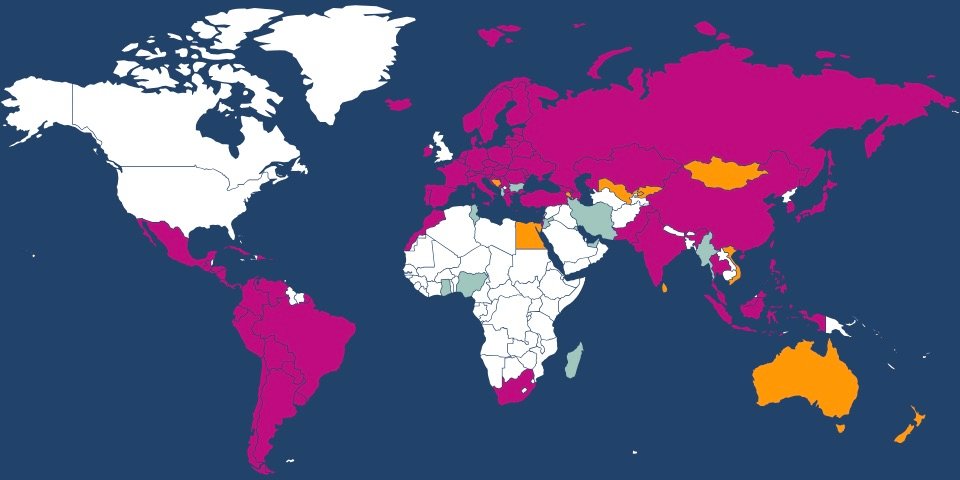
FULL MEMBER.
Austria – Azerbaijan – Bahrain – Belarus – Belgium – Bolivia – Brazil – Chile – China – Colombia – Costa Rica – Croatia – Cuba- Cyprus – Czech Republic – Denmark – Dominican Republic – Ecuador – El Salvador – Estonia – Finland – France – Georgia – Germany – Gibraltar – Greece – Guatemala – Honduras – Hungary – Iceland – India – Indonesia – Ireland – Israel – Italy – Japan
Kazakhstan – Korea (Republic Of) – Latvia – Lithuania – Luxembourg – Malaysia – Malta – Mexico – Moldavia (Republic Of) – Monaco – Montenegro – Morocco – Nicaragua – North Macedonia – Norway – Pakistan – Panama – Paraguay – Peru – Philippines – Poland – Portugal – Puerto Rico – Romania – Russian Federation – San Marino – Serbia – Singapore – Slovakia- Slovenia – South Africa – Spain – Sweden – Switzerland – Taiwan – Thailand – The Netherlands – Turkey – Ukraine – Argentina Uruguay – Venezuela (Bolivarian Republic Of)
ASSOCIATE MEMBER
Armenia – Australia – Bosnia and Herzegovina – Egypt – Kirghizistan – Kosovo – Mongolia – New Zealand – Siri Lanka – Uzbekistan – Vietnam
CONTRACT PARTNER
Albania – Bulgaria – Lebanon – Ghana – Iran (Islamic Republic of) – Jordan – Kuwait – Madagascar – Myanmar – Nigeria – Tunisia – United Arab Emirates.